The Accelerated Pace of the Win9x Era (1995 to 2001)
Update on September 13th, 2026: It's been exactly one month since the release of my book. Once again, I wanted to thank anyone that purchased it through Google/Amazon (FYI a Kindle device/tablet is not required - there's a free Kindle app for Win11 PCs, Androids, and iPhones, plus their web-based browser page). It'll also be sold on Itch later this year, and it will be free on Itch for everyone who bought it beforehand.
If you bought it but then ended up back here afterwards, then feel free to send me an e-mail or look me up on my semi-active Instagram, whether it's to talk about the era itself, your personal experiences, your views of the book, or anything else.
Although as of this writing there aren't any reviews on Amazon/Google, sales have definitely exceeded my initial predictions. So, again, thank you for taking a chance on my debut offering!
Thank you for taking an interest in my book about the Win9x era. This site is a simple home for my project's release. In a nutshell, my book covers the Win9x era of computing (1995 to 2001). I'm of the opinion that the Win9x era has been either misdocumented or overlooked. An accelerated pace in technology (and expectations) led to an interesting yet impactful time period. There's been plenty of coverage on individual aspects of course, but my aim was to bundle everything together in one tightly wrapped package. I am hoping to shine a light on the era, via simultaneously presenting some nostalgia while classifying the time period under one cohesive umbrella.
To purchase the e-book, click on one of the following platforms:

(if you're outside of the US, then click here to goto the bottom of the page to choose your specific country's marketplace)

(for Google, this button should universally work for all countries)
############################################
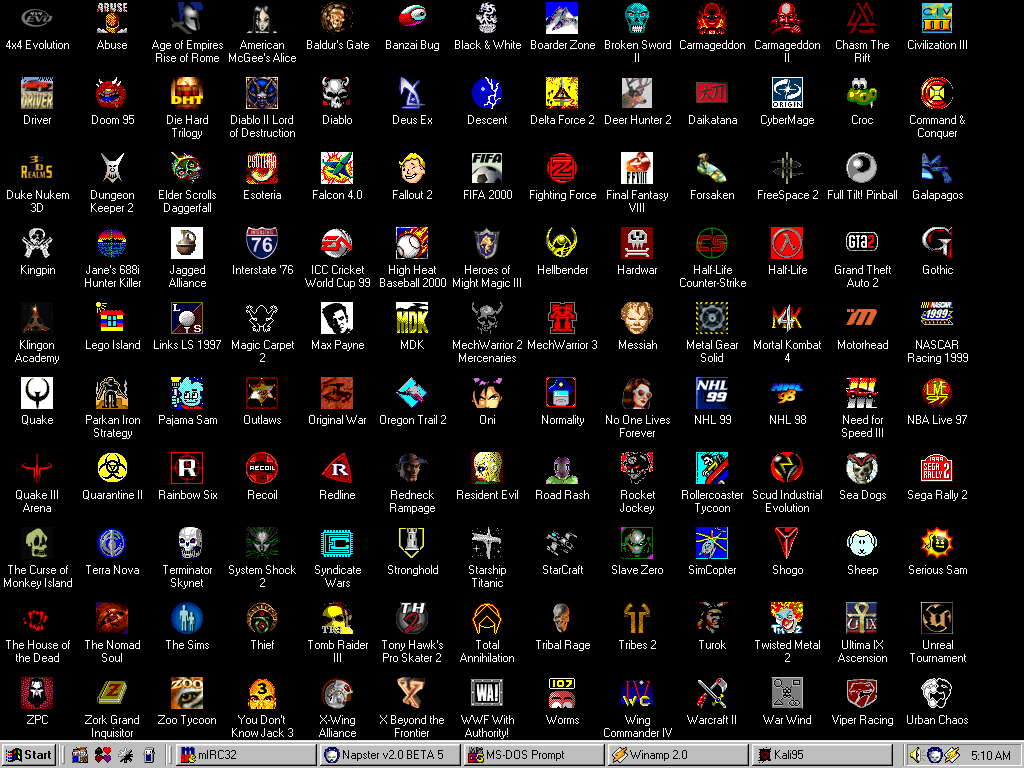
Why there's certain games in the image above...
The desktop screenshot simply consists of a random selection of my personal favorites and some obvious popular titles (FYI it's sorted alphabetically: start in the top-left corner and go right till the end -> go down 1 row -> go left till the end -> go down 1 row -> repeat). The actual contents in the book are much more diverse and unbiased.
What's actually inside the book...
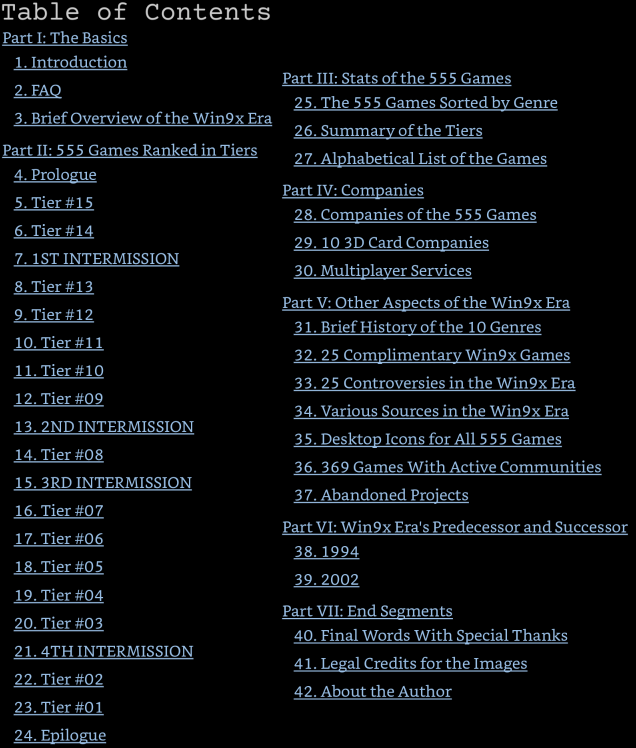
There are 42 chapters (divided by seven parts) which cover the Win9x era:
- 555 games ranked within 15 tiers, with each game having two screenshots, release info such as years/companies involved/genres, and anywhere from four to seven paragraphs of text
- Brief background history on the Win9x era
- Quick rundown of 10 prominent 3D companies of the era
- Going over the era's multiplayer services
- Blurbs on the 10 main genres covered in the book
- Digging out some abandoned projects
- Explaining 25 controversies of the era
- Small highlights of 25 freeware games from the era
- Listing of 369 games with active (as of 2026) communities
- Desktop screenshots of the 555 games' icons
- Highlights from the Win9x era's direct predecessor (1994) and successor (2002)
How games are ranked...
Crucially, my personal preferences did not affect the rankings. I took a contemporary (era-accurate) approach to both the rankings and the writing overall. You won't find any first-person pronouns in the text either; thus, everything reads in a straightforward historical manner. The rankings are determined by three things:
- #1. A game's actual pros and cons from the view point of when the game was first released (and not how it plays/looks in 2026). I try my best to point out the factual traits of a game. Since everyone enjoys different things when playing a game, I put myself in the shoes of someone who typically adores the style. I'm not a mind-reader and I may not always be successful, which is why I considered other factors as well.
- #2. In another section, there's a list of 30+ sources from the Win9x era. After I experienced and wrote about a game, I consulted the sources to see what was written at the time. If something didn't align with what I experienced (or I overlooked something), I went back and re-played/re-wrote it, if it was necessary.
- #3. I compared each game to other games (of the same style) that arrived before/near it, and nothing after. I did this off-paper, and it was basically a way to gauge expectations through a contemporary approach.
Explaining the tiers...
I decided on the tier system early on, mainly because it's not meaningful to compare drastically different genres against each other, and also to avoid a forced yet rigid 1-to-555 ranking. For example, someone's #1 game might be a first-person shooter title while another person's #1 game might be a real-time strategy title. As a result, all 37 games in tier #1 are considered 1st, all 37 games in tier #2 are considered 2nd, all 37 games in tier #14 are considered 14th, and so on. This creates an even playing field overall due to the mishmash of styles in the era.
Did I really play all 555 games...
Yes, all but four of them (since those four relied on defunct online servers). I actually played more than 555 since I had to exclude/re-include/exclude again/replace games as well. A good handful I've played at one point prior to starting this project as I got my first PC in late 1997, but even those games I revisited over the past few years too. Of course, I couldn't complete every game start to finish (though many of them I did). In those instances, however, I played it to the point where I felt comfortable enough to write about it, whether it was two hours of in-game time or six hours of in-game time, it was always different. Since this was just a side hobby, sometimes I spent a week straight on the project and sometimes I took a break for a month; thus, nothing was rushed.
Did I copy anything from somewhere else...
I typed every word, captured every screenshot (except for eight of them due to offline servers), and formatted every page myself. There is a dedicated chapter for legality credits in the back of the book however.
Choosing 1995 to 2001 as the timeline...
I feel like 1995 to 2001 is the ideal timeframe for the Windows 95/98 era. The obvious bookends are Windows 95's release in late 1995 and Windows XP's release in late 2001. The timeframe also lines up with some of the era's significant moments. From 1995 to 2001, we had:
- Worldwide adoption of the internet as it went from dial-up to cable/DSL within only a few years
- Popularization of new genres such as real-time strategy and third-person shooting
- 3D accelerators enhancing graphics which finally matched the arcade cabinets
- An accessible yet a bit flawed operating system which eliminated many of the headaches caused by DOS
- An influx of print magazines dedicated to PC gaming
- Laptops which handled gaming to an extent
- Processors reaching the 1GHz mark and beyond
- The birth of competitive online gaming, as full-blown leagues, LAN events, and internet tournaments cropped up on a large scale for the first time
- Popularization of influential hardware such as USB, compatible sound cards, mice with scroll wheels plus ones with optical sensors later on, force feedback joysticks, headphones with voice-over-net technology, ZIP disks, DVDs, CD burners, Bluetooth, and an increased importance on graphics cards
- Broader factors such as economic growth in the US/UK and the IT sector's expansion, amongst many other cultural and technological shifts
Everything happened in the span of about seven years. No time period is perfect, and there were plenty of downfalls and tragedies along the way too, but at least there were a lot of positives as well.
The reason why this is only an e-book...
Publishing a physical edition as the first run proved to be difficult. This is because (to the best of my knowledge)... the Win9x gaming scene has never been written in this fashion before and so it's uncharted territory & the Win9x era isn't an extremely popular topic as a whole & I'm a first-time author & the large amount of text and images would seem daunting in the eyes of a publisher. Ultimately, I resorted to a digital edition, although if a physical edition ever emerges, there's a lot of additions that I'd like to include (some of which is already written but I had to cut due to limitations).
############################################
Again, I truly thank you for visiting this site and taking an interest. Please visit Amazon or Google to purchase the book (it will also be sold on Itch later in the year, and anyone who buys it on Amazon/Google before then, will receive a free voucher if they want it through Itch as well). If you want to contact me for any reason, feel free to e-mail me: win9xera@gmail.com
Australia
Brazil
Canada
France
Germany
India
Italy
Japan
Mexico
Netherlands
Spain
United Kingdom
United States